Cold Morning Tpms Light Tyre Top Up Uk
Direct answer: on a frosty UK morning, a tyre pressure warning can appear because cold tyres are reading lower than they did yesterday. Treat it as a real warning, but do not jump straight to "puncture" or "keep driving". Check the tyre condition first, inflate all four tyres to the manufacturer's cold pressure, then watch whether one tyre loses pressure again.
The key habit is simple: use the pressure on the vehicle placard, handbook or door card, not the maximum number printed on the tyre sidewall. The Highway Code's vehicle-maintenance guidance tells drivers to keep tyres correctly inflated and to check them weekly when cold, which is exactly the situation a driveway top-up solves best.
What to do before you inflate
Start with the boring safety check. Look for an obviously flat tyre, a bulge, a cut, exposed cord, a nail sitting near the sidewall, or fresh damage after a kerb strike. If you see any of those, do not treat the pump as the fix. Move the car only if it is necessary to get out of danger, then use breakdown help or a tyre fitter.
If the tyre looks intact and simply soft, read the cold pressure from the door card or handbook. If the car offers loaded and lightly loaded pressures, choose the one that matches how the car is being used today. Select the same unit on your gauge or pump, because confusing PSI and BAR is an easy mistake when the warning has already put you under pressure.
The cold-morning top-up sequence
- Park on level ground before the journey, with tyres still cold.
- Check all four tyres, not only the wheel that looks soft.
- Inflate each tyre to the manufacturer's cold pressure.
- Refit every valve cap and listen briefly for leakage at the valve.
- Drive normally for a short distance or follow the handbook reset process if your car asks for one.
- Recheck later the same day, or the next morning, if one corner was much lower than the others.
Toyota UK's TPMS guidance explains that some warning lights clear after correct inflation and driving, while others need a reset routine. That difference matters: the pump fixes low air pressure, not the car's monitoring system.
When it is probably not just the weather
A cold snap usually affects all four tyres in the same direction. Be more suspicious if one tyre is much lower than the rest, if the same corner drops again after a top-up, or if the TPMS light flashes rather than staying steadily illuminated. TyreForce's cold-weather tyre-pressure guide frames winter pressure loss as a checking prompt, not a reason to ignore repeat loss.
Do not overinflate just to silence the warning light. Overinflation can change the way the tyre contacts the road, and it does not solve a leak, a damaged valve or a sensor fault. The right target is still the manufacturer's cold pressure.
Where a portable inflator fits
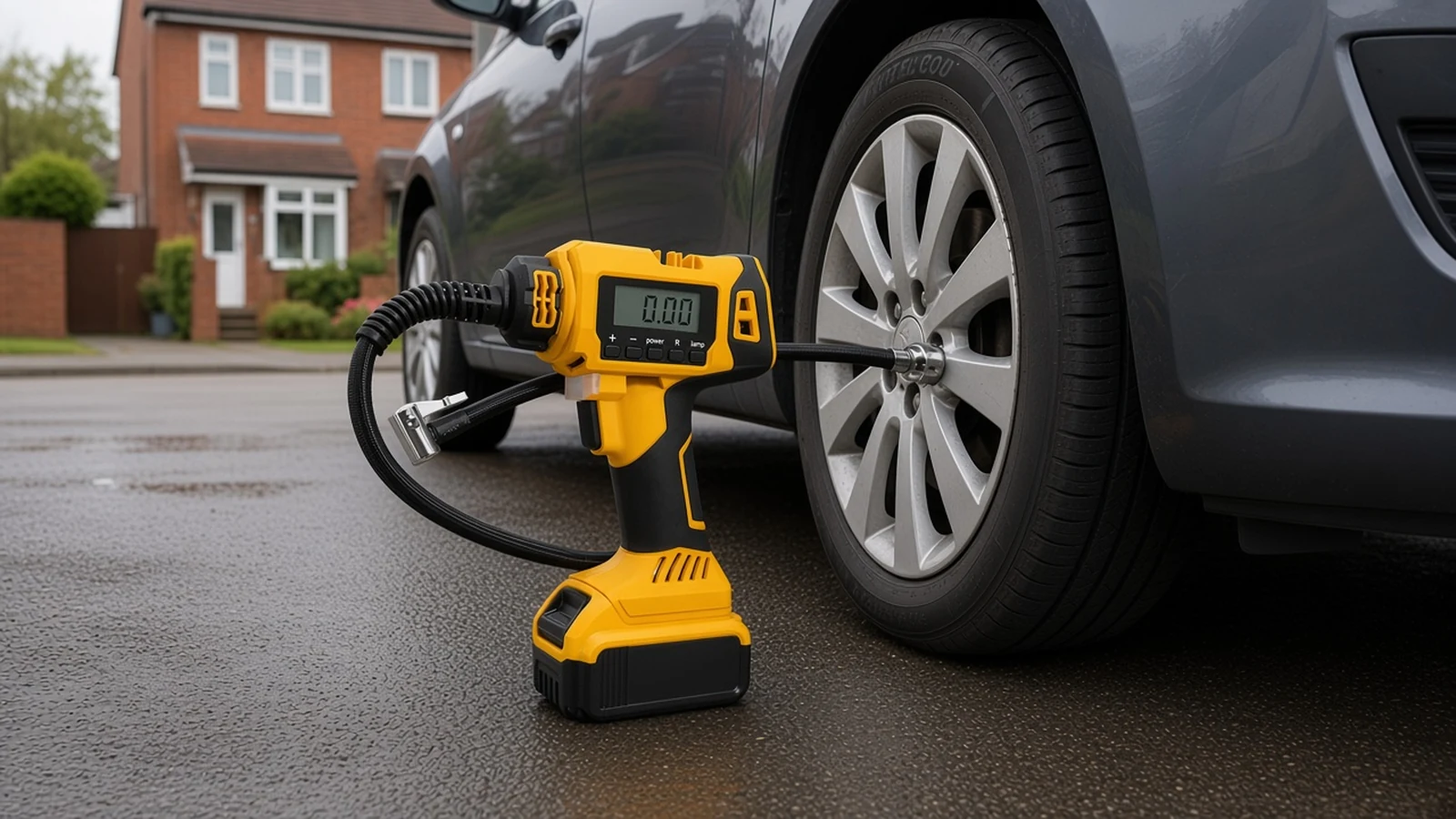
A charged digital auto-stop inflator is useful because it lets you solve the ordinary part of the problem at home, before the school run, commute or motorway journey warms the tyres. It is most relevant when the tyre is intact, the car is on your driveway or in a safe parking place, and you know the target pressure.
It is not a puncture-repair kit, a sidewall-damage solution or a TPMS diagnostic tool. If the warning returns quickly, treat that as useful evidence: the car is telling you to find the leak or the sensor fault, not to keep topping up forever.
Quick decision check
- Proceed with a top-up: tyre looks intact, pressure is only modestly low, you can inflate cold to the door-card figure.
- Top up then book inspection: one tyre was notably lower, but it holds pressure long enough for a controlled trip to a fitter.
- Do not drive as normal: tyre is flat, damaged, bulging, losing air quickly, or the warning behaves like a sensor/system fault.